Fetterman tells Congress to hurry up and ‘make weed legal’
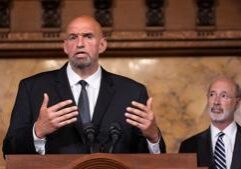
U.S. Sen. John Fetterman, D-Pa., and over a dozen of his colleagues in the upper chamber have re-upped their calls to end the federal ban of marijuana.
On Tuesday, Fetterman’s office sent out a press release announcing his support for the reintroduction of the Cannabis Administration and Opportunity Act, which he said would remove cannabis from the list of federally controlled substances and, as a result, empower states to create their own laws.
“I’ve always been very pro-weed,” Fetterman said. “In a very libertarian slant: I’m not going to judge anyone for using it to knock the edge off of life. I think your path to wellness should be without judgement or punishment—legal, safe, and regulated.”
“I supported President Biden and President Trump when they took steps on the issue,” he added. “But it is time for Congress to stop d—— around and make weed legal. This bill is a good step forward.”
The bill, filed on Thursday, has 17 co-sponsors, all of whom are Democrats.
According to Marijuana Moment, the latest effort is “largely similar” to versions filed in the two previous sessions of Congress, although the most recent proposal contains new provisions on hemp, specifically preventing the federal recriminalization of hemp THC products that is scheduled to take effect in November.
Fetterman believes the latest proposal provides a wide variety of benefits.
The proposal, according to Fetterman, would protect public health in a number of ways, including the establishment of a Center for Cannabis Products, which would regulate production, labeling, distribution, sales, and other manufacturing and retail elements of the cannabis industry, while also establishing programs and funding to prevent youth cannabis use.
In an effort to protect public safety, Fetterman said the proposal requires the Department of Transportation to create standards for cannabis-impaired driving and incentivize states to adopt cannabis open-container prohibitions.
This bill would also regulate and tax cannabis by transferring federal jurisdiction over cannabis to the Alcohol and Tobacco Tax and Trade Bureau, or TTB, eliminating the tax code’s restriction on cannabis businesses claiming deductions for business expenses and implementing an excise tax on cannabis products, and establishing market competition rules meant to protect independent producers, wholesalers, and retailers and prevent anti-competitive behavior.
Cannabis research is also encouraged in the bill in a variety of ways, including requiring the Government Accountability Office to study and report on metrics that may be impacted by cannabis legalization and requiring the Department of Health and Human Services, HHS, and the National Institutes of Health, NIH, to conduct or support research on the impacts of cannabis.
The bill would also establish grants to build up cannabis research capacity at institutions of higher education, with a particular focus on minority-serving institutions and Historically Black Colleges and Universities, HBCUs.
In an effort to prioritize justice, Fetterman said the bill establishes a Cannabis Justice Office at the Department of Justice’s Office of Justice Programs and would use federal tax revenue to fund an Opportunity Trust Fund to “reinvest in communities and individuals most harmed by the failed War on Drugs.”
Fetterman also believes the bill would strengthen workers’ rights by removing federal employee pre-employment and random drug testing for cannabis and would establish grants for community-based education, outreach, and enforcement of workers’ rights in the cannabis industry.
A variety of cannabis reform supporters back this proposal, according to Marijuana Moment, including the Drug Policy Alliance, Doctors for Drug Policy Reform, and Cannabis Regulators of Color Coalition.
Twenty-four states have legalized recreational marijuana, Forbes reports, while 35 have passed legislation to permit the medicinal use of cannabis.
Fetterman has a long record of calling for the legalization of marijuana and led a statewide listening tour on the matter during his time as lieutenant governor.
Marijuana regulations have also been in the news during Trump’s second term. In April, Acting U.S. Attorney General Todd Blanche issued an order immediately placing both FDA-approved marijuana products and marijuana regulated by state medical licenses in Schedule III of the Controlled Substances Act.
That move by the federal government was celebrated by Fetterman and Gov. Josh Shapiro.
However, Marijuana Moment notes that the GOP majority in the U.S. House has advanced legislation this Congress to block the Trump administration from carrying out marijuana rescheduling.
U.S. Sen. Dave McCormick, R-Pa., has a different view on marijuana policy.
In December, he signed a joint letter with 21 of his Republican Senate colleagues to the Trump administration opposing reclassifying the drug.
“Rescheduling marijuana to a Schedule III drug will undermine your strong efforts to Make America Great Again and to usher in America’s next economic Golden Age,” the senators write in the letter to the Trump administration. “The only winners from rescheduling will be bad actors such as Communist China, while Americans will be left paying the bill.”
During a telephone town hall that same month, McCormick referred to himself as a “big advocate of the use of medical marijuana” but said at that time he was “opposed to rescheduling Marijuana from Schedule I to Schedule III.”
A Susquehanna Polling and Research survey conducted in April showed that 72% of Democrats, 67% of Republicans, and 64% of independents support the legalization of recreational marijuana in Pennsylvania.
However, because of the decision by the Trump administration in April, any marijuana not sold through a state medical program or approved by the FDA remains Schedule I.




Slight Chance Rain Showers then Mostly Cloudy
Latest News Stories

Democratic senators under fire explain why they supported GOP bill to end shutdown
Giannoulias ramps up campaign for state regulation of auto premiums

Illinois quick hits: Illinois U.S. senators split on shutdown vote

End to government shutdown in sight after senators make funding deal
Will County Saves Nearly $5.74 Million in Bond Refinancing, Explores Future Borrowing Options

Will County Board Advances New Speed Limits in Green Garden and Frankfort Townships
New Lenox Garage Variance Denied After Neighbor Cites ‘Massive’ Scale and Neighborhood Impact
State Veto Session Passes Energy Bill Limiting County Zoning, Approves Toll Hike for Mass Transit

Large naval presence in Caribbean ahead of Ford arrival
Voting rights group warns CA redistricting push could undermine trust in IL
Chicago downtown office space vacancy rate jumps to record high levels

Commission Approves Peotone-Area Farmhouse Split, Overruling Staff’s “Spot Zoning” Concerns
Will County Finance Committee Hits Impasse on 2025 Tax Levy, Postpones Budget Votes

Federal court backs union on feds’ partisan emails